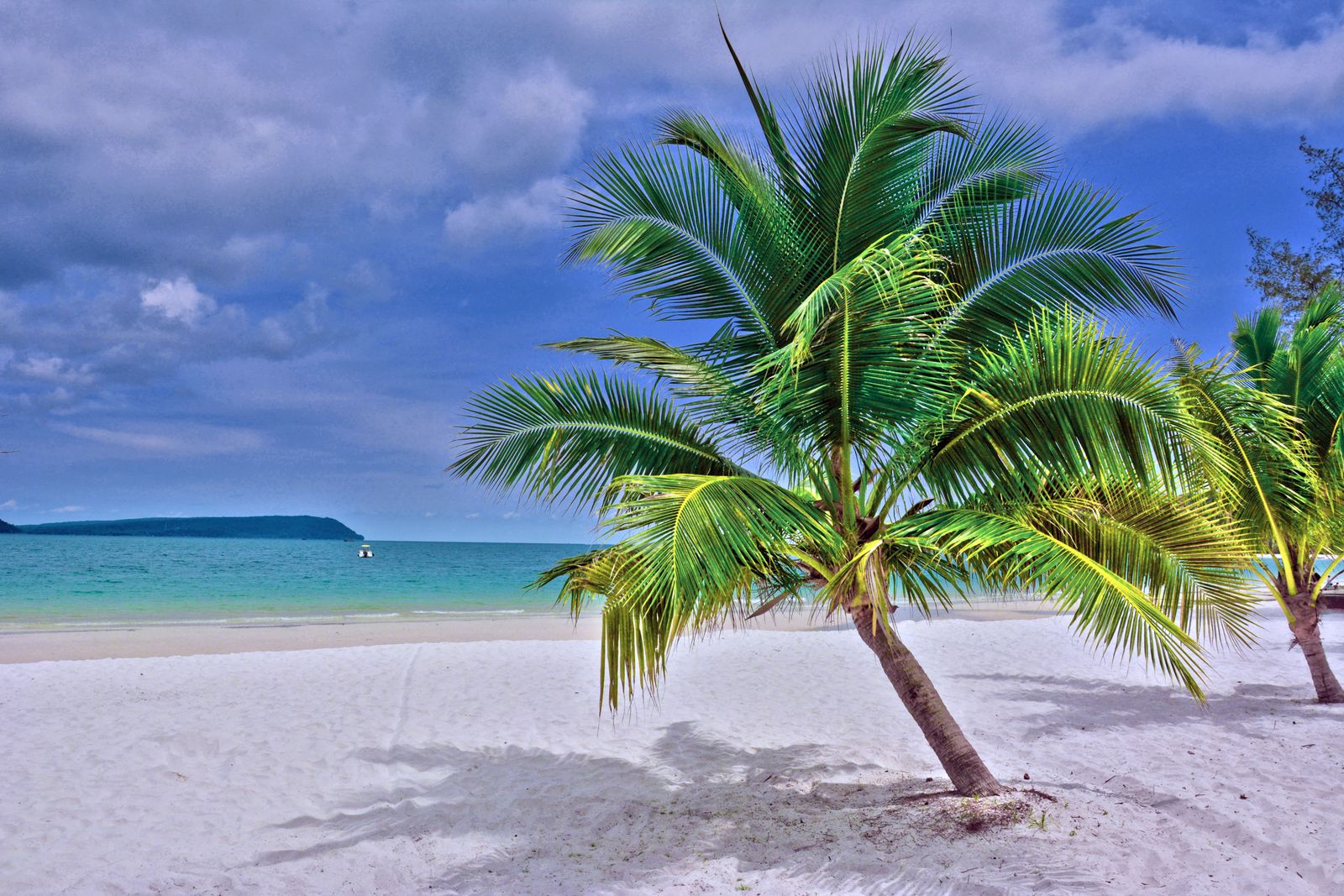
Cambodia
Cambodia is known above all for Angkor — the temples of the Khmer Empire, whose heyday fell in the 10th–13th centuries.
Climate and nature
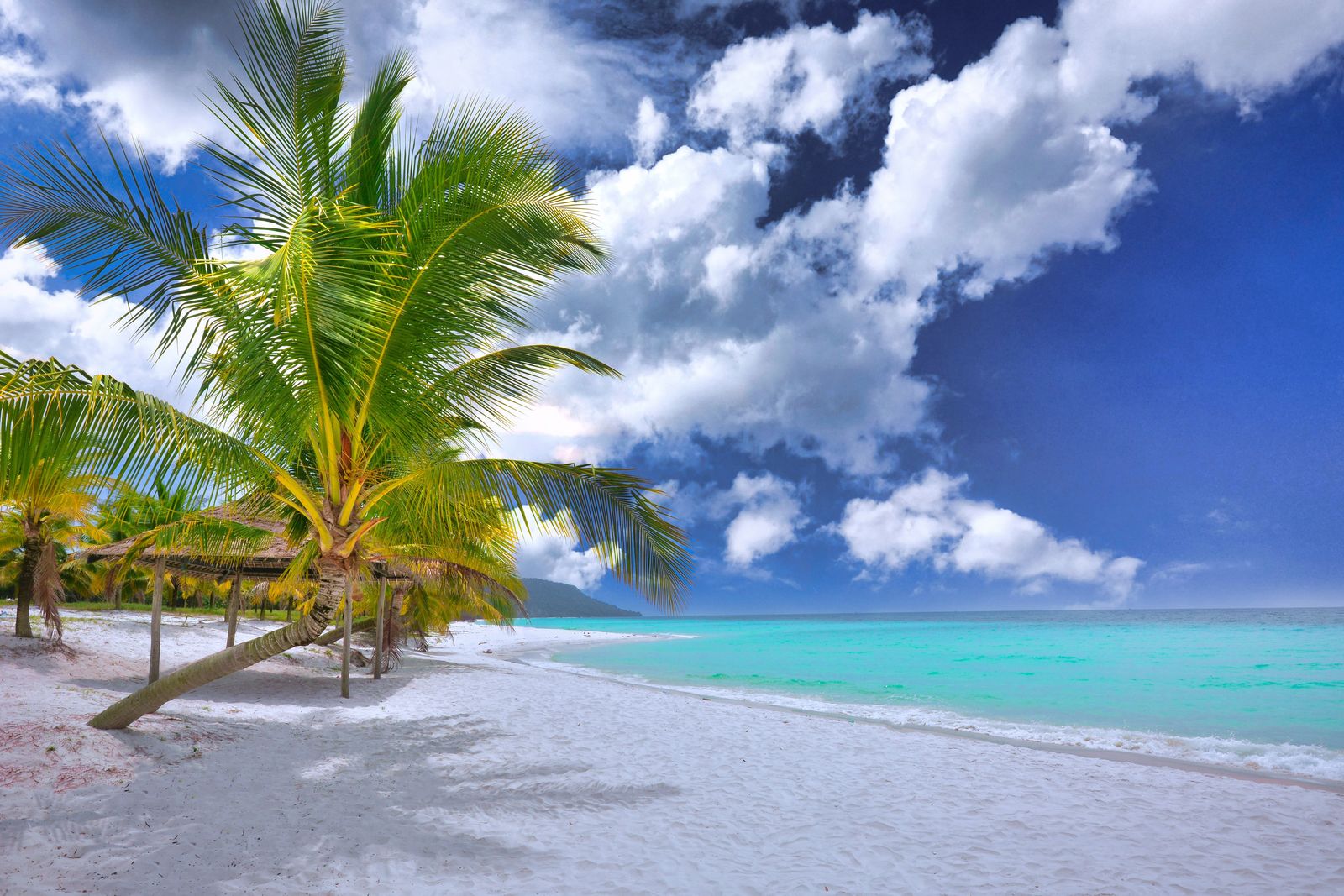
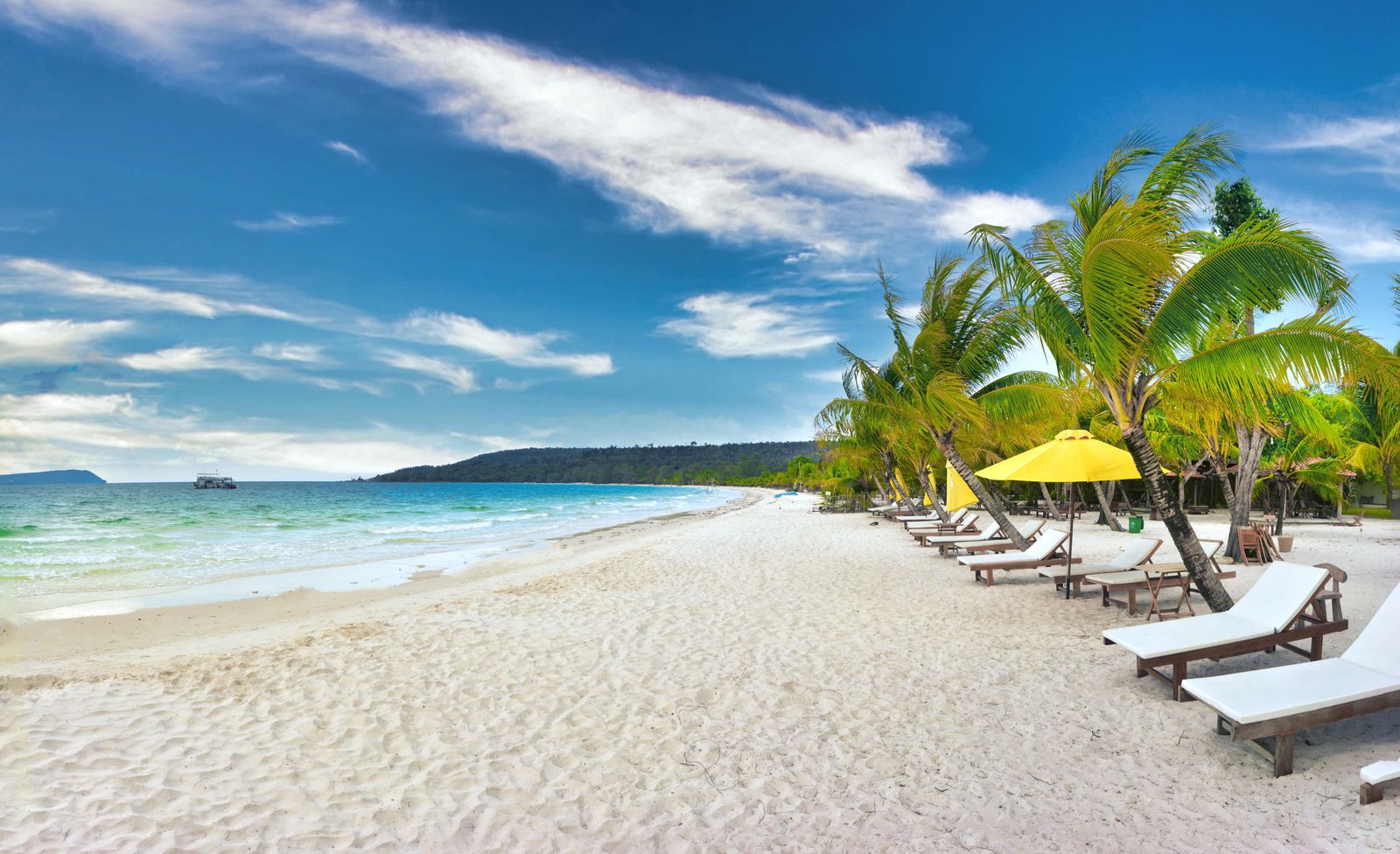
Nature is no less attractive: Tonle Sap lake grows to 16 thousand square kilometres in the rainy season, and along the coast of the Gulf of Thailand lie the island of Koh Rong and the Ream and Bokor national parks. The climate is tropical and monsoonal: the rainy season lasts from May to November, the dry season from December to April.
- Climate: tropical, monsoonal: rainy season from May to November, dry season from December to April; almost no seasonal variation in temperature
- Coastline: 443 km
- Languages: Khmer (official, 95.8%), minority languages 2.9%, Chinese 0.6%, Vietnamese 0.5% (2019)
- Currency: riel (KHR)
- Time zone: UTC+7
History, culture and what to see
Cambodia is known above all for Angkor — the temples of the Khmer Empire, whose heyday fell in the 10th–13th centuries. The best-known monument, Angkor Wat, was built in the 12th century and is dedicated to Vishnu. Other UNESCO sites: the Preah Vihear temple on a mountain plateau, the ruins of Ishanapura at Sambor Prei Kuk, and the pyramid of Koh Ker. Nature is no less attractive: Tonle Sap lake grows to 16 thousand square kilometres in the rainy season, and along the coast of the Gulf of Thailand lie the island of Koh Rong and the Ream and Bokor national parks. The climate is tropical and monsoonal: the rainy season lasts from May to November, the dry season from December to April. Most inhabitants are Buddhists, and the main language is Khmer. The country is developing tourism and the textile industry, and its capital Phnom Penh remains the largest city.
What to see and how far it is from our places
- Angkor Wat (UNESCO). A temple complex built in the 12th century by King Suryavarman II and dedicated to the god Vishnu. The site covers 162.6 hectares, and its carved galleries and towers make it the main symbol of Cambodia. On the UNESCO World Heritage list since 1992. Siem Reap — 6 km, Phnom Penh — 235 km, Sihanoukville — 312 km.
- Koh Ker (UNESCO). An archaeological complex of the 10th century about 120 km from Siem Reap. In 928–944 it was the capital of the Khmer state. Known for a seven-tiered pyramid and more than 180 sanctuaries. Inscribed on the UNESCO list in 2023. Siem Reap — 87 km, Phnom Penh — 249 km, Sihanoukville — 368 km.
- Sambor Prei Kuk (UNESCO). The ruins of Ishanapura, the capital and royal sanctuary of the Chenla state. The building of Hindu temples began in the 7th century under King Isanavarman I. The complex is in Kampong Thom province and has been on the UNESCO World Heritage list since 2017. Siem Reap — 139 km, Phnom Penh — 145 km, Sihanoukville — 300 km.
- Preah Vihear (UNESCO). A Hindu temple dedicated to Shiva and built on a mountain plateau about 625 metres above sea level. Construction began in the early 9th century, and the main part was built in the 11th–12th centuries. A UNESCO World Heritage site since 2008. Siem Reap — 145 km, Phnom Penh — 315 km.
- Royal Palace (Phnom Penh). The Royal Palace in Phnom Penh, the official residence of the King of Cambodia. Construction began in 1866 under King Norodom, and the throne hall opened in 1919. The complex still serves as the monarch's residence today. Phnom Penh — 1 km, Sihanoukville — 186 km, Siem Reap — 231 km.
- Ream National Park. A national park on the coast near Sihanoukville, established in 1993. It protects mangrove forests, seagrass meadows, beaches and coral reefs, as well as dugongs, turtles and sarus cranes. Land area more than 140 sq. km. Sihanoukville — 27 km, Phnom Penh — 175 km, Siem Reap — 318 km.
- Koh Rong. The second largest island of Cambodia, in the Gulf of Thailand off Sihanoukville. About 43 km of sandy beaches along a 61-kilometre coastline, with wooded hills and waterfalls behind. On the island is the Koh Rong Marine National Park, the first in the country. Sihanoukville — 31 km, Phnom Penh — 205 km, Siem Reap — 302 km.
- Beng Mealea. A Hindu temple about 40 km east of the Angkor temples. Built mostly of sandstone and dedicated to Vishnu, dated by scholars to the early 12th century. Barely restored, known for carvings with scenes from Hindu mythology. Placed on the UNESCO tentative list in 2020. Siem Reap — 43 km, Phnom Penh — 225 km, Sihanoukville — 327 km.
- Tonle Sap. The largest freshwater lake in Southeast Asia. In the dry season its area is about 2,700 sq. km, in the rainy season up to 16,000 sq. km, because the Tonle Sap river changes the direction of its flow. A UNESCO biosphere reserve since 1997, it provides a significant share of Cambodia's freshwater catch. Siem Reap — 58 km, Phnom Penh — 173 km, Sihanoukville — 258 km.
- Bokor National Park. A national park established in 1993 on a plateau about 1,000 m high. The highest point is Phnom Bokor mountain, 1,081 m. Preserved here are a French hill station of 1921, a Catholic church of 1928 and a 29-metre statue completed in 2010. An ASEAN Heritage Park since 2003. Sihanoukville — 62 km, Phnom Penh — 125 km, Siem Reap — 279 km.
Now to business
Strengths first, then the essentials of the market. As of 11 October 2026.
The market in brief
- A foreigner does not buy land. A foreigner may own an apartment or an office in a registered co-owned building: not on the ground floor, not more than 70% of the area of all the units in the building, and not closer than 30 km to a land border.
- By law the buyer pays a 4% stamp duty. An agency advises setting aside a further 6–10% of the price for all related costs.
- Capital gains tax on sale is 20%. For real estate, the sources give the start date differently: 1 January 2026 or 1 January 2027.
- Citizenship is available only through a large investment in priority sectors or a contribution to the state budget, not by buying an apartment.
Worth keeping in mind
- There are no restrictions on transferring money through authorised banks; the bank reports transfers of 10,000 dollars and above to the National Bank.
- A Cambodian housing price index is not yet available in our base, so we cannot say whether prices rose or fell.
- The main risk is the legal basis: many rules are recorded from pages of law firms and agencies dated 2014–2023, and on inheritance the agency relies on a 2006 draft code.
Details
Open what matters to you. The sections come from the knowledge base and grow with it.
What and where a foreigner can buy
- An apartment or an office in a co-owned building — in one's own name. The limit is 70% of the area of all units in the building (per a DFDL law firm page, 2014, law of 2010; not confirmed by an official text). The ground floor and underground floors are not available to a foreigner. Our records on floors differ: one says "from the first floor up", another "from the second".
- Land — does not belong to a foreigner. Commercial land is not held directly either; per an agency page, a trust (law of 2019) or a long lease is possible.
- Phnom Penh, Siem Reap, Sihanoukville. The rule is the same across the country; for Phnom Penh the agency separately writes that condominiums can be bought and resold. We have no records of our own for Siem Reap and Sihanoukville.
What it costs to buy, hold and sell
Buying:
| Item | Amount | Who pays |
|---|---|---|
| Stamp duty on transfer of the right | 4% of the tax base: the value per the Ministry of Finance table, or, where there is none, the price in the contract | by law the buyer; in practice the parties may agree otherwise |
| Lawyer, registration and other fees | per an agency example: 1,500–2,500 dollars lawyer, about 100 dollars registration | buyer |
| All related costs (including furniture, connections, lawyers) | 6–10% of the price — an estimate by the agency IPS Cambodia | buyer |
Example from an agency record for a house at 150,000 dollars in Phnom Penh: 4% — 6,000, a further 0.1% — 150, lawyer 1,500–2,500, registration about 100. Total 7,750–8,750 dollars, that is 5.2–5.8% on top. This is the agency's example, not a norm of the law. The relief for new apartments up to 210 thousand dollars applied until the end of 2025.
Holding:
- Property tax — 0.1% a year of the base: 80% of the assessed value of the land and building less 100 million riel (about 25,000 dollars). Below the threshold nothing is paid. In rural areas of the provinces the tax does not apply. The payment deadline is 30 September. This is the official page of the General Department of Taxation.
- Tax on unused land — 2%.
Selling:
- Capital gains tax — 20% of the difference between the sale price and permitted expenses (order of the Ministry of Economy and Finance N496 of 18.07.2025, per a KPMG page). For real estate one may deduct 80% of the proceeds without documents — then the tax is about 4% of the price — or the actual expenses.
- The start date for real estate is disputed: KPMG and Rajah & Tann give 1 January 2026, another record gives a postponement to 1 January 2027 by notice of the tax department (as retold by DFDL; we have not seen the official text).
- There is an exemption for a main home held for at least five years, and only for one home per family. A non-resident's rented apartment, judging by the text, does not fall under it: this is a conclusion from the text, not a direct quotation.
Rental
- Long-term letting of housing. Confirmed records are not yet available; we will provide them on request.
- Short-term letting. Two sources differ. A page about the country: a licence for tourism activity under the tourism law is needed. A page about Phnom Penh: there are no special rules for short-term rental, ordinary business registration is needed. Neither page is official.
- Tax on rent — 10% of gross income, expenses are not deducted; rent up to 500,000 riel a month is exempt (official clarifications of the tax department; order N169 of 20.03.2024).
- 14% withholding. If the tenant is a resident carrying on a business and pays a non-resident, the tenant withholds 14% (per a page of the law firm Andersen, not confirmed by an official one).
- Discrepancy. The IPS agency page writes that a foreign investor pays 14% on rent and a resident 10%. The official clarifications give a single rate of 10% and treat 14% as withholding at source. We describe it by the official page and give both figures.
This is the tax in Cambodia. Tax in the investor's country of residence is calculated separately.
Mortgage
The IPS Cambodia agency page (January 2023) writes that a mortgage is possible for a foreigner, but the choice is limited. The banks named are RHB, Canadia, Vattanac, Public Bank and ABA; credit is given most readily against an apartment in a condominium. The page does not state the loan share of the price or the term, and we have not opened the pages of the banks and the regulator. Terms should be checked with the bank.
Residence permit and citizenship
- Residence permit: no records in our base yet; we will provide them on request.
- Citizenship: sub-decree N225 of 1 December 2025 (per a page of the law firm Andersen). Possible with a personal investment of 4 billion riel (about $990k) or more in priority sectors and approved projects (an investment permit is needed), or with a contribution of 12 billion riel (about $3m) or more to the budget. Real estate in general does not qualify as a priority sector.
Prices: four lines
A Cambodian housing price index is not yet available in our base: the Bank for International Settlements does not publish such a series, or it has not been loaded by us. For that reason the four kinds of price, with and without inflation adjustment, in local currency and in dollars, are not given here, and we draw no conclusions on dynamics.
Places and districts
The reference base has 40 districts: Phnom Penh 19, Siem Reap 12, Sihanoukville 9. There are no prices for them from dated listing and review pages that we have read. Official data on buyers and the number of transactions are also not yet available in our base.
Commercial property
- What a foreigner can own. A unit, including an office, in a registered co-owned building on the same terms as housing (DFDL page, 2014; it does not speak of offices directly, this is a conclusion). Commercial land directly — no.
- How it differs from housing. Almost not at all. Property tax of 0.1%, stamp duty of 4% and tax on unused land of 2% are the same (tax department strategy 2019–2023; it names no differences for commercial property).
- Tax on rent — the same 10% of gross income for residential and commercial property, exemption up to 500,000 riel a month.
- VAT — general rate 10% (official clarifications). Per the IPS agency, a landlord that is a company must register for VAT; an individual letting to an individual does not issue invoices.
- Where it is concentrated. Phnom Penh: BKK1 (the foreigners' district, offices, shops), Chroy Changvar Bay (offices), Daun Penh (the retail core around the Central Market), Koh Norea and Koh Pich (mixed districts). Siem Reap: Sala Kamreuk, the old town, Svay Dangkum. Sihanoukville: Serendipity and Victory Beach.
Buying off plan
Buying from a developer is by payments at construction stages; escrow and written guarantees are needed (per an agency page). The agency advises tying payments to verified stages, not to dates. What the law requires we have not checked.
Who sells and where to look
Developers in the reference base: Borey Peng Huoth, CamKo City (World City Co., Ltd.), Chip Mong Group (Chip Mong Land), OCIC Group, Sokimex Investment Group, The Royal Group.
Listings: IPS Cambodia, Khmer24, KhmerHome, Realestate.com.kh.
Family: safety, education, inheritance
Safety. There are no recent data. The latest World Bank value is for 2011 — 1.82 serious incidents per 100 thousand inhabitants; the series is empty after that. The UK Foreign Office most often names a bag snatched from a passing motorbike. The monsoon season runs from June to October: strong storms damage roads, landslides restrict travel to some provinces, and in Phnom Penh roads flood because of poor drainage. The same source: the country is heavily contaminated with landmines, and areas are often not marked.
Education. Phnom Penh has two International Baccalaureate schools: International School of Phnom Penh (three programmes, grades up to 12) and Northbridge International School Cambodia (ages 2–18). Annual tuition at Northbridge for 2026/27 is from 11,550 dollars (youngest group) to 30,475 dollars (grades 11–12), plus an annual fee of 1,440–2,840 dollars and one-off charges. This is one school. A state school for a foreign child, schools in Siem Reap and Sihanoukville, universities — not yet available; we will provide them on request.
Inheritance. There is no inheritance tax (per IPS Cambodia, article of 2021; not confirmed by an official page). Compulsory shares exist: up to half of the property may be left freely to outsiders, and if the heirs are parents or a spouse, the compulsory share is about a third. The agency refers to the 2006 draft Civil Code; the code in force took effect on 21.12.2011, and we have not opened its text. A foreigner may inherit, but cannot keep land without citizenship; per one source, it must be sold within three months (not confirmed against the code in force). Transfer of real estate between close relatives by inheritance is exempt from the 20% capital gains tax; the start dates are disputed in the same way as in section 2. Which law applies and whether it can be chosen is not yet available in our base.
What else we will do for you
The review answers the general questions. Then your own story begins — and we are with you at every step.
We work out your exact tax
For your passport and the country you live in: on purchase, ownership, letting and sale.
We gather real prices
For the district and the building you like: what actually sells and for how much.
We show you properties
Options for your goal and budget, and a viewing on site or by video.
We check the developer and the papers
Title, permits, the record of completed buildings — before you pay anything.
We handle the paperwork
The deal, registration of title, residence for the family, a bank account.
We stay with you after the purchase
Letting, management, reporting — and the sale when the time comes.
For this country we will find out for you
Where to begin?
Tell us what matters to you, and we will start from your task, not from a catalogue.